
Author
David Fehrenbach

David is Managing Director of preML and writes about technology and business-related topics in computer vision and machine learning.
We are thrilled: our AI-based camera inspection system, developed together with ZOLLERN GmbH & Co. KG, has won the MATERIALICA Design + Technology Award 2026 in the “Process” category.
For us, this is more than a trophy for the shelf. The award shows that AI in production is no longer a topic for the future. It is a tool that saves real costs on the line today.
In this article, we look at the problem the system solves, how it is built technically, and why we deliberately chose a different approach here than the anomaly detection we usually write about.

Media 1: Winner in the “Process” category: the AI camera inspection system by ZOLLERN and preML wins the MATERIALICA Design + Technology Award 2026.
+++Build your first AI model in just 5 minutes – get started for free with preML Vision Lab now! +++
The problem: a defect found late costs twice
Anyone working in manufacturing knows the situation: a material defect only shows up at final inspection. By then, the part has already gone through several processing steps. Each of these steps cost machine time, energy and labour, and in the end it all ends up as scrap anyway.
The old rule of thumb from quality management fully applies here: the later a defect is found, the more expensive it gets.
At ZOLLERN, steel profiles are pretreated first. They are blasted before moving on to further production steps. This is exactly where the opportunity lay: if a profile already has a material defect, it should not continue down the line at all.
The task was clearly defined:
- detect material defects as early as possible
- inspect every single part, not just samples
- do all this without slowing down production
The solution: three cameras, all-round inspection in real time
The inspection system sits directly in the blasting process. Three cameras are arranged so that they capture every profile from all sides. A defect on the underside is found just as reliably as one on the top.
What makes the system work in daily operation:
- Real time: Every profile is evaluated while it passes through. The result is available before the part moves on to the next step.
- All-round inspection: Three camera angles cover the entire profile, with no blind spots.
- 100 % inspection: Every product running on the conveyor is inspected, not just a sample.
- No impact on production: The conveyor does not have to stop or slow down for inspection. The existing process stays exactly as it is.
- Fully automatic: Nobody has to stand at the line and watch. Defective material is detected and can be rejected.
On top of that, a blasting system is not a friendly environment for cameras. Dust, blasting media and vibration are part of everyday life. So the system not only has to detect well, it also has to run reliably under these conditions over the long term.
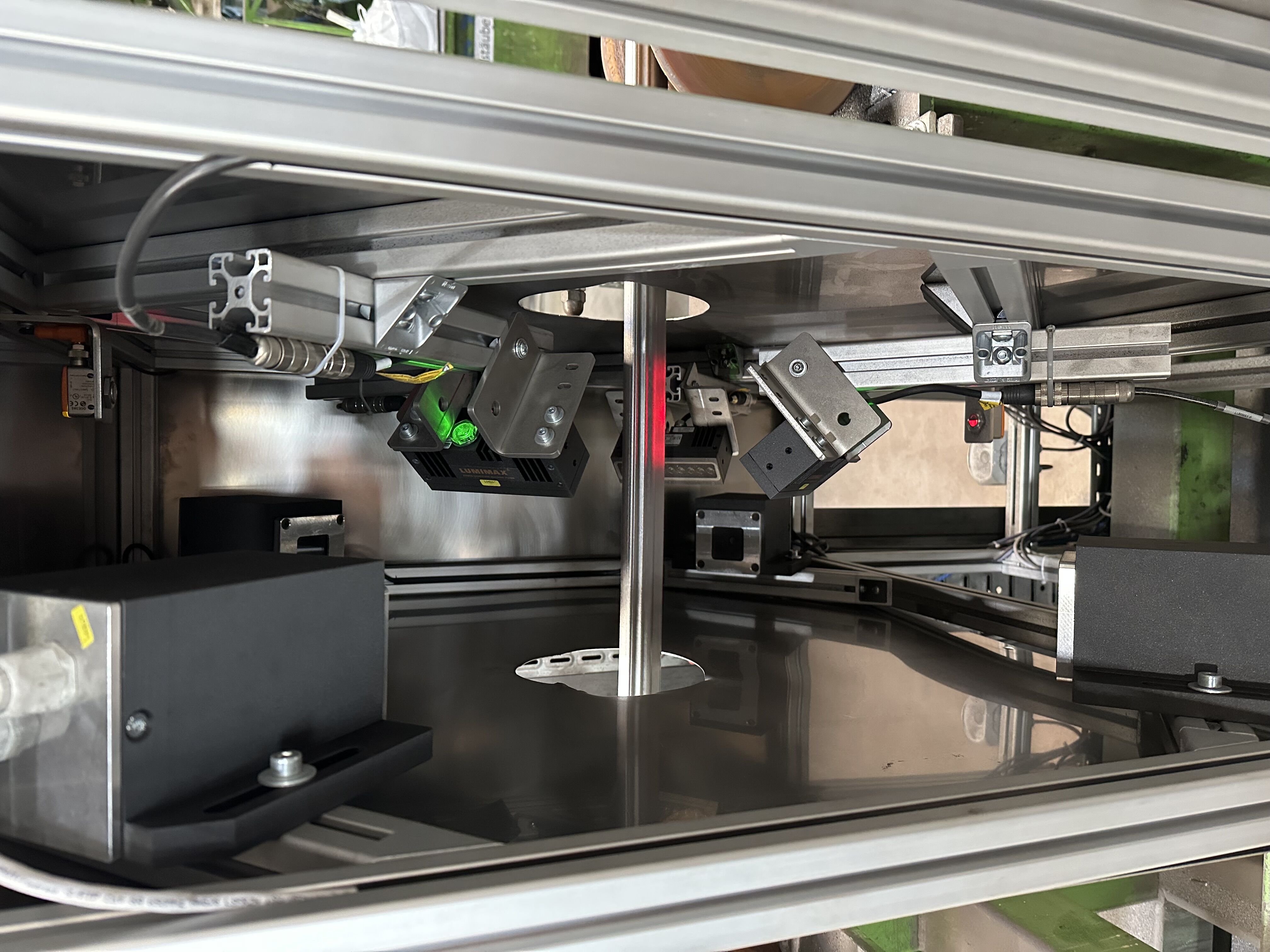
Media 2: Three cameras inspect the steel profiles from all sides directly in the blasting process, without the line having to stop.
Why we train with defect images here
If you follow our blog, you know we are big fans of anomaly detection. There, the model only needs images of good parts, learns “this is what normal looks like” and flags everything that deviates. At ZOLLERN, however, we deliberately chose a different path: supervised learning.
The difference is easy to explain with two inspectors:
- Anomaly detection is like an inspector who only knows what a good part looks like. Anything different gets put aside.
- Supervised learning is like an inspector who has been shown a defect catalogue beforehand: “This is defect A, this is defect B, and this one is still fine.”
Supervised learning plays to its strengths when the defect types are known and example images can be collected. And when the surface is naturally irregular, as with blasted steel. In that case, “looks different” is not a good enough criterion. The model has to know which deviation is a real defect and which is not.
The trade-off: more effort is needed at the start, because defect images have to be collected and labelled. In return, the system does not just say “suspicious”, it also tells you which defect it is. As always, our rule is:
We choose the approach that fits the inspection task, not the other way around.
What the team on the line sees
The best detection is of little use if nobody understands the result. That is why the system includes an interface that anyone can read at once, without AI knowledge. The team sees at a glance how production is running and can understand, for every flagged profile, why it was rejected.
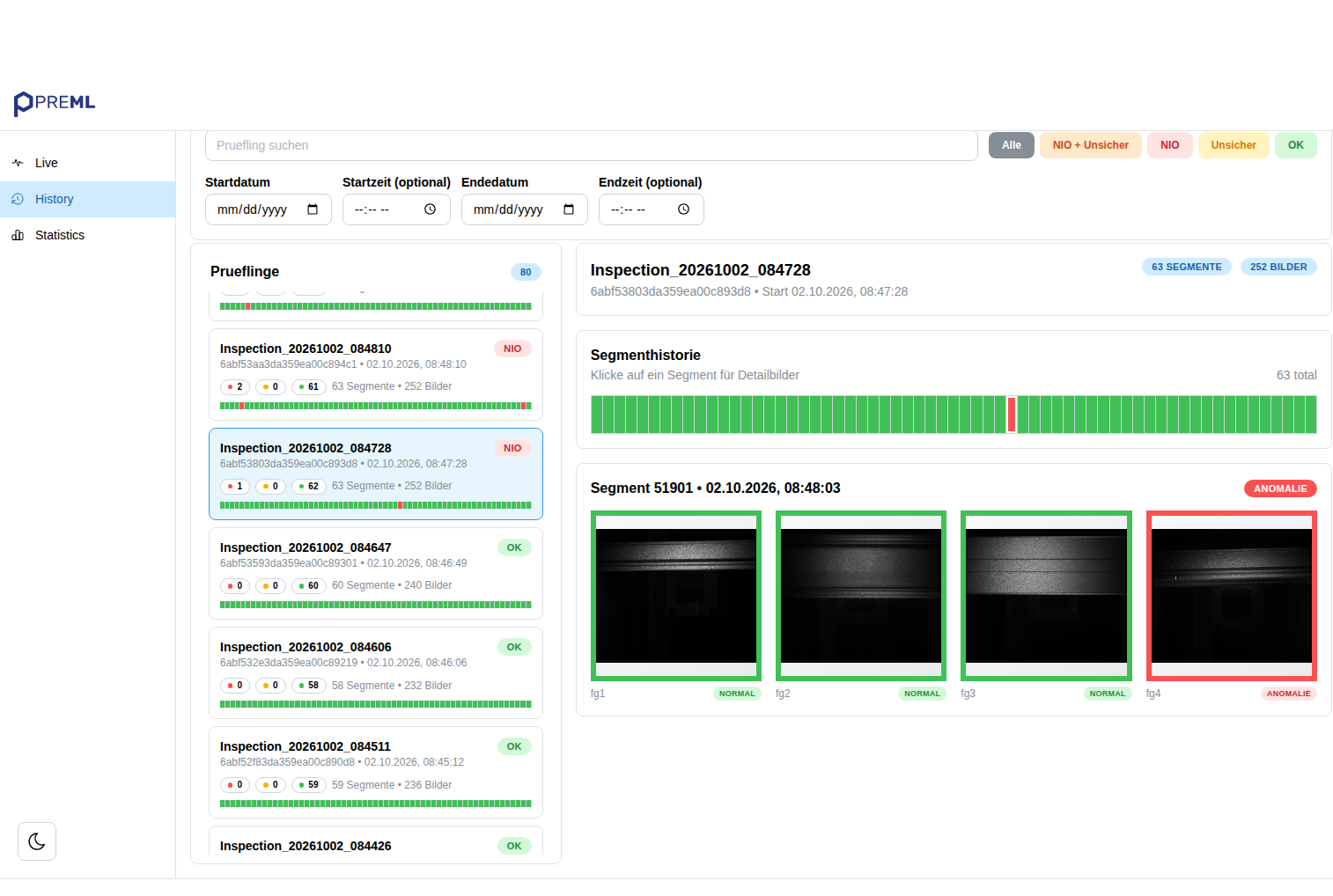
Media 3: The overview displays the steel profiles divided into individual profile images. If a defect is detected in an image, the corresponding area is highlighted in red.
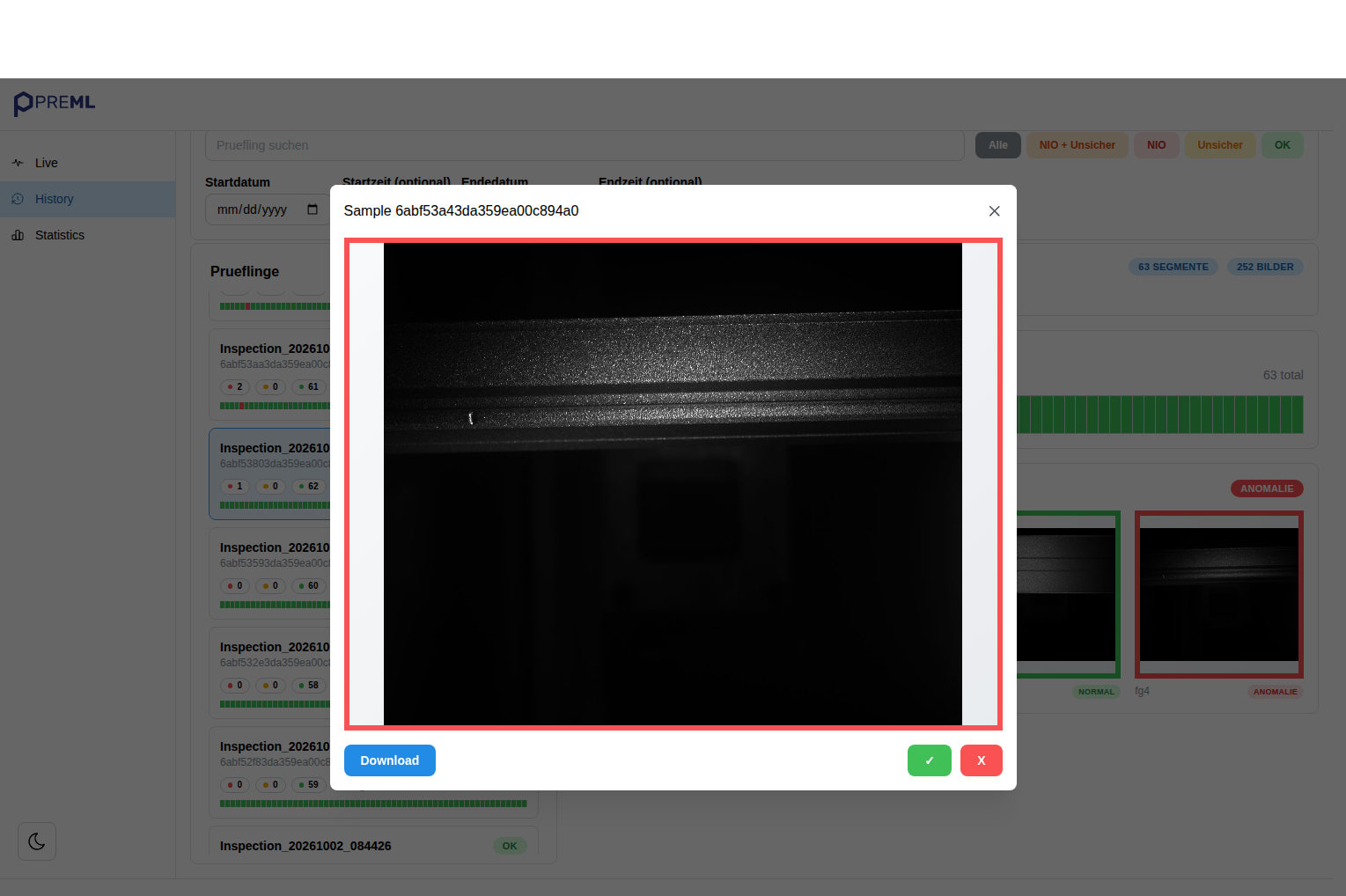
Media 4: Detailed view of a detected defect. This allows every decision made by the system to be directly verified against the image.
Conclusion: quality starts at the beginning of the process chain
The idea behind the system is simple: find defects where they don’t cost anything yet. If a profile is rejected right at the blasting stage, every further processing step is saved. In concrete terms, this means:
- less processing of defective material
- lower energy and resource consumption
- fewer unnecessary production steps
- a more stable process and more consistent quality
A big thank you goes to the team at ZOLLERN. Without their process knowledge and the opportunity to develop directly in real production, this project would not have been possible. It is exactly this combination of manufacturing experience and AI know-how that makes solutions like this ready for the real world.
Do you have a similar inspection task in your production, where defects are found too late? Feel free to get in touch, and we will take a look at your use case. Or leave a comment on where in your process chain early inspection would make the biggest difference.
Cheers!
David
Weitere Blog Posts zum Thema:
MATERIALICA Award 2026 – AI camera inspection at ZOLLERN
We are thrilled: our AI-based camera inspection system, developed [...]
Anomaly Detection for Automated Quality Inspection: 10 Real-World Use Case
For anyone working with machine vision and automated inspection [...]
Human in the Loop for AI-Based Anomaly Detection
Our new Feedback Loop feature enables continuous improvement of [...]
Autor
David Fehrenbach
David is Managing Director of preML and writes about technology and business-related topics in computer vision and machine learning.